You do not need to remove an entire lawn before growing vegetables or flowers. I have found that how to start a no-dig garden bed over grass comes down to three things: blocking light, adding enough compost, and sealing every gap.
The method replaces backbreaking sod removal with cardboard and organic matter. You can build the bed in an afternoon, often without turning the soil once.
What Is a No-Dig Garden Bed?
A no-dig bed is built above the existing soil rather than carved into it. Cardboard smothers the lawn, while compost creates the new planting surface.
This approach is also called sheet mulching, sheet composting, or lasagna gardening. Oregon State University describes sheet mulching as using cardboard or paper to deny weeds the sunlight needed for growth.
The cardboard eventually decomposes. Meanwhile, the grass beneath it dies and adds organic material to the soil.
No-dig gardening also avoids unnecessary soil disturbance. That helps preserve soil structure while reducing the amount of physical work needed to create a bed.
Materials Needed for a No-Dig Bed
I gather every material before mowing because wet cardboard becomes difficult to reposition.
You will need:
- Plain brown corrugated cardboard
- Finished compost or well-aged manure
- A garden hose
- A rake
- A mower or string trimmer
- Straw or shredded leaves
- Bricks, logs, stones, or boards for optional edging
Remove packing tape, plastic labels, staples, and shipping pouches from every box. Avoid glossy, waxed, or heavily coated cardboard. Iowa State University Extension also recommends avoiding waxed cardboard and glossy paper in sheet-mulched beds.
Use mature compost with an earthy smell. Fresh manure may contain excessive salts, viable weed seeds, or enough nitrogen to damage young plants.
How to Start a No-Dig Garden Bed Over Grass
Choose and Mark the Site
Choose a level area that receives enough sunlight for your planned crops. Most fruiting vegetables perform best with at least six hours of direct sun.
Mark the bed before spreading materials. I prefer beds about 3 to 4 feet wide because I can reach the center without stepping on the compost.
Keep the bed away from tree trunks and large surface roots. Building thick layers over tree roots can reduce oxygen movement and create moisture problems.
Mow the Grass Very Short
Mow the lawn as low as your mower safely allows. Short grass creates a flatter surface and reduces the chance of tough blades lifting the cardboard.
Leave the clippings in place unless they contain mature weed seeds or herbicide residue. The clippings will break down beneath the barrier.
Water dry soil before adding cardboard. Moist soil supports decomposition better than hard, dusty ground.
Remove Problem Weeds
Cardboard controls ordinary lawn grass well, but it is not magic. Dig out thick crowns, woody weeds, and seed heads before covering the site.
Pay close attention to plants that spread through underground stems. Bermudagrass, bindweed, nutsedge, quackgrass, and Canada thistle can escape through edges or planting holes.
For aggressive weeds, extend the cardboard beyond the planned bed. Continue checking the perimeter during the first growing season.
Lay Overlapping Cardboard
Place one or two layers of plain cardboard directly over the cut grass. Avoid stacking many layers because excessive cardboard can restrict water and air movement into the soil.
Overlap every seam by at least 6 inches. I use wider overlaps near lawn edges because those areas receive the strongest grass pressure.
Cover small holes, handles, and torn corners with extra pieces. Sunlight reaching one exposed patch can keep the grass alive.
Oregon State University recommends overlapping paper barriers so light cannot reach the vegetation below. Its guidance also says cardboard should be soaked with water.
Soak the Cardboard
Wet the cardboard until it becomes flexible and lies flat. A light spray is not enough.
Soaking helps the sheets settle around minor bumps. It also stops wind from moving the cardboard while you add compost.
Do not leave wet cardboard exposed overnight. Wind can lift the edges, while drying may cause the sheets to curl.
Add a Deep Compost Layer
Spread 4 to 6 inches of finished compost over the wet cardboard. Use the deeper end of that range when planting immediately or covering vigorous grass.
Rake the surface level, but do not compact it heavily. A firm yet crumbly surface gives roots moisture and oxygen.
The U.S. Environmental Protection Agency reports that compost can improve soil structure, water retention, infiltration, fertility, and beneficial soil-organism populations.
A very shallow layer dries quickly and may not support deep-rooted seedlings. It also gives surviving grass less distance to travel before reaching light.
Plant or Let the Bed Settle
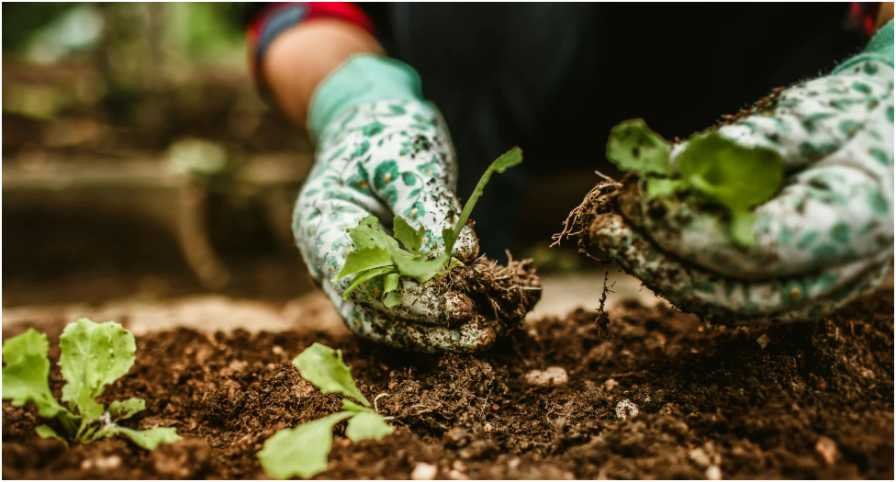
You can plant transplants directly into a 4-to-6-inch compost layer. Make holes only in the compost rather than cutting through the cardboard unnecessarily.
Small seeds need fine, screened compost near the surface. Remove large sticks and unfinished pieces before sowing carrots, lettuce, or radishes.
When planting large transplants, I sometimes cut a small X in the softened cardboard. I use this only when the root ball is deeper than the compost.
A fall-built bed can settle over winter before spring planting. A spring bed can be planted immediately when the compost is mature and deep enough.
My Light-Gap Test for Better Weed Control
Before adding compost, I stand on one side of the bed and look across the cardboard at ground level. Any bright line, open seam, torn handle, or exposed grass receives another patch.
This takes less than five minutes. It is easier than pulling grass from the middle of a planted bed later.
I also inspect the outer 6 inches separately. Most failures I see start at the perimeter, not in the center. Lawn runners enter from uncovered edges where the cardboard ends too neatly.
For a cleaner boundary, extend the cardboard past the bed frame. Trim the excess only after the compost and edging are in place.
How Much Compost Will You Need?
Material estimates prevent an unfinished bed and an emergency trip to the garden center.
A 4-by-8-foot bed covers 32 square feet. At 6 inches deep, it needs about 16 cubic feet of compost. That equals roughly 0.6 cubic yard.
Use this simple formula:
Length × width × depth in feet = cubic feet
For a 6-inch layer, use 0.5 feet as the depth. Divide the cubic-foot total by 27 to estimate cubic yards.
Order slightly more than the calculation suggests. Compost settles after watering, rain, and planting.
When Is the Best Time to Build the Bed?
Fall is my favorite time because rain keeps the layers damp and winter gives the grass time to decompose. The bed is usually easier to plant by spring.
Spring construction also works. Use finished compost and plant transplants rather than relying only on tiny direct-sown seeds.
In hot, dry regions, build the bed before extreme summer heat. Cardboard and compost dry quickly when installation is delayed during hot weather.
UF/IFAS notes that no-dig beds use layered compostable materials to smother grass and suppress weeds as the materials decompose.
Common No-Dig Garden Mistakes
The most common mistake is leaving gaps between cardboard sheets. Even narrow openings can become channels for grass and perennial weeds.
Another mistake is using too little compost. Two inches may work as a landscape mulch, but it is not a generous planting layer for a new vegetable bed.
Do not mix fresh wood chips into the compost layer. Wood chips work better on paths or as a surface mulch around established plants. Mixing them into the root zone may temporarily reduce available nitrogen as they decompose.
Avoid walking on the finished bed. Repeated foot traffic compresses compost and reduces the loose structure that makes no-dig gardening useful.
Finally, do not assume the cardboard provides permanent weed control. It decomposes, so long-term weed suppression depends on dense planting, regular mulching, and quick removal of new weeds.
Maintaining a No-Dig Bed
Add about 1 to 2 inches of finished compost to the surface each year. There is no need to mix it deeply into the bed.
Keep the surface covered with shredded leaves, clean straw, or another suitable organic mulch. Mulch reduces evaporation and limits new weed germination.
Water slowly so moisture reaches the full compost layer and the soil below. The Best way to water raised garden beds also applies here: water deeply at soil level rather than spraying leaves for a few minutes.
Check the edges every week during the first season. Pull grass runners before they root inside the bed.
Rotate crops where possible, and remove diseased plant material. Leave healthy roots in the soil after harvest unless they interfere with the next planting.
Frequently Asked Questions
1. Can I put a no-dig garden directly over grass?
Yes. Mow the grass short, cover it completely with overlapping cardboard, soak it, and add 4 to 6 inches of finished compost.
2. How long does cardboard take to kill grass?
Grass often weakens within several weeks, but full decomposition may take months. Temperature, moisture, grass type, and cardboard thickness affect the timing.
3. Can I plant immediately after starting a no-dig bed?
Yes, provided the compost is mature and deep enough. Transplants establish more reliably than deep-rooted seeds in a newly constructed bed.
4. What is the best cardboard for a no-dig garden?
Use plain brown corrugated cardboard without glossy coatings, wax, tape, plastic labels, staples, or large areas of heavy colored printing.
Skip the Shovel and Start Growing
Learning how to start a no-dig garden bed over grass turns an unused patch of lawn into productive growing space without stripping away the soil.
The method succeeds when you treat gaps as the enemy and compost depth as non-negotiable. Mow low, overlap generously, soak thoroughly, and build a deep planting surface.
Mark out one manageable bed first. Once it is covered and planted, that untouched patch of lawn will look far less permanent.